Category: Minor Leagues
Q&A with former ‘Cap Castellanos
Well, Nick Castellanos has been mentioned on this blog about a billion times, so one more time probably won’t hurt anything. He did have a great season with the Toledo Mud Hens this past summer, that earned him a call up to the Detroit Tigers in September. Despite not making the playoff roster, many believe he has a great shot a being the Tigers’ everyday left fielder in 2014 (with the Tigers trading Prince Fielder, he looks to have a shot at starting at third base now). Also mentioned many times before, we had the luxury of watching him play for the West Michigan Whitecaps back in 2011, and he was nice enough to sign a baseball for Lily. So, here is another interview from MiLB.com, this one done by Sam Dykstra. Enjoy…
 MiLB.com: One of the big things coming into this season for you was the move to the outfield. How did you approach the position switch?
Castellanos: I think I approached it pretty well. They were trying to find a spot for me in the lineup with Prince [Fielder] signing and Miguel [Cabrera] moving over to third. I know I’m not going to be playing third base as long as Miguel is in the organization, so when they approached me to make the move, I knew it was just about trying to find a spot for me, and that was easy to take. It’s going to be my best path to the big leagues right now, and that’s a good thing. I do miss third base, though. Eventually at some point, I’d love to go back.
MiLB.com: How long did it take to you get to comfortable out there in left field?
Castellanos: It was difficult at the beginning, to be honest. I had never played outfield in my life before that. It’s not like I was trying to learn shortstop again, like I did in high school, or making a move over to second. I had never done that in my life, so it was a different feeling out there. I felt uncomfortable at the beginning, with the game being so far away. But I have to give credit to our outfield coordinator, Gene Roof. He spent all day and all night with me trying to get everything down, and I feel much better out there.
MiLB.com: Another part of the transition was the move up to Triple-A Toledo. What was that like?
Castellanos: I had to mature a lot more up there, that’s for sure. You’re facing great pitchers, day in and day out. In Triple-A ball, every guy you’re facing has their approach down and knows exactly what they’ll do with you when you come up to the plate. Plus, the bullpens in Triple-A are just day-and-night better than the ones you’re facing at the lower levels. You just have to get a feel for some of the flamethrowers, make adjustments like anywhere else and be prepared for what you’ll see.
MiLB.com: That being said, you were able to handle Triple-A pitching fairly well. Why was that?
Castellanos: I think that just goes to my confidence at the plate. All I need are at-bats and a little bit of time, and things usually get around to where they need to be.
MiLB.com: Where does that confidence and your general hitting prowess come from?
Castellanos: Most of it is that I’m always working on hitting. I’ve been hitting all the time since I was little, since I started playing really. I’m always trying to learn about the game I love, and the only way I can do that is to keep working hard at it. With that, whether I’m 0-for-4 or 4-for-4 on a given day, I’m still having fun at the plate because I like it so much up there. That amount of fun contributes to my success a little. I don’t mind putting work in because I enjoy it that much.
MiLB.com: Because of that hitting ability, you were able to get a callup to the Tigers in September during their playoff run. Describe that experience.
Castellanos: Just because who I am, I wish I got to play more when I was there, but they were competing to finish first in the division and stuff, so that happens. I got to start four games, and I was pretty happy with the way I hit when I did start. But for me, playing off the bench is difficult, you know? When I come to the park, I’m ready to go and want to get out there. I got some pinch-hit at-bats in the seventh inning or later, so that was something I had to get used to — preparing starting in the sixth, being on call, stuff like that. But above all, it was about getting used to the Major League life — the plane rides, what time to get to the field, what to do in the pregame. It was a good learning experience for that stuff.
MiLB.com: One of the things about joining that Tigers team, too, is that it’s a squad that is heavy with veterans. Was there anyone you sought out in particular?
Castellanos: First, everybody in that locker room is such a great guy. It’s easy to come into as a rookie because of that. But one guy that’s super-knowledgeable and just a super guy overall is Torii [Hunter]. He makes himself so open and so approachabl,e not only to the veterans but to the rookies like myself, too, and that’s a big help.
MiLB.com: What did you talk to him about specifically?
Castellanos: Above all, they were mostly outfield questions. I’d watch him out there and then try to pick his brain about why did he go after a ball here and why did he go that way there. The thing about Torii is that he picks up pitches so well. So if I saw him do something that I wouldn’t have seen otherwise, I tried to talk to him about it. Overall, he just makes the game fun. He’s been in the game for 17, going on 18 years, so it’s great he can share stuff with me.
MiLB.com: Besides Hunter, it must have been interesting to play with Miguel Cabrera, not only because of who he is, but because you’re a guy from the Miami area.
Castellanos: It is pretty wild. In ’03, I watched the World Series with him in it, and I was actually there when he went “oppo” against Clemens after he threw at him. I was idolizing Cabrera when I was little, and then the first run I scored in the Majors was driven in by Miguel. It’s cool how everything comes full circle like that. Being 10, 11 and watching him play and now I’m with him on the field. Beyond that too, Alex Fernandez — my coach in high school — won a World Series with Jim Leyland, and I played under him too. Just cool how that all happens.
MiLB.com: Speaking of Leyland, you got to play under him right before he retired. What was that like?
Castellanos: Leyland is very professional in everything he does. From a player’s perspective, he’s fun to watch and has been doing it for so long. I think someone said that he’s filled out something like 4,800 lineup cards in his career. Anyone with that much experience in baseball, you know you have to listen and respect what they do. I feel like I know so much about baseball already. But compared to Leyland, and beyond that, [bench coach Gene] Lamont and [former hitting coach and recently named Mariners manager Lloyd] McClendon? I don’t know anything. All I can do is watch them, learn and see how Jim would manage a game, even if that meant sitting there thinking, “Why would he do this?” Being around him, I was able to just add a lot of knowledge that wasn’t there.
MiLB.com: Leyland’s also known in baseball circles as a fairly colorful character. Got any good Leyland stories?
Castellanos: The biggest thing that comes to mind is one day [Sept. 4] we got beat pretty bad by the Red Sox. It was the day [David] Ortiz got his 2,000th hit, and we lost by a lot [20-4]. I went into the clubhouse thinking, “Man, if we’re in Toledo right now, we’re going to get chewed out.” And then he walks in and just says, “Well, tomorrow’s a great day for an off-day, huh?” And that was it. It was really loose and easy, and it was his way of telling us to pick up our heads and keep on pushing through because there were a lot of other big games coming up.
MiLB.com: After those big games were through, the Tigers moved onto the playoffs, but you were left off the postseason roster. How did you handle that?
Castellanos: It was pretty nerve-racking, knowing I couldn’t help or contribute in any way. All I could do is watch from my living room in Miami. There were even a couple of times I had to turn off the TV because I couldn’t watch anymore.
MiLB.com: Many see you as likely to be on the big league roster come Opening Day. How do you approach the offseason with that in mind?
Castellanos: Pretty much like any other offseason really. I don’t want to put any added pressure on myself. I just have to work hard and be ready come spring, just like I always have.
MiLB.com: If it does come down to it, that you are the starting left fielder for the Tigers on Opening Day, how ready do you feel for that opportunity?
Castellanos: Oh, 100 percent. With the instruction I’ve gotten from the people that have helped me in the outfield, I know I’m ready. I know I can help the team right now. It’s tremendously exciting to think about. Any time you play in the big leagues is a great opportunity, and I’m ready to do that every day.
MiLB.com: With all this being said, probably the biggest thing to happen to you this year was the birth of your first child. Does Liam have a bat in his hand yet?
Castellanos: No, he’s only three months so he hasn’t touched anything yet, but he does have a couple of gloves and a couple of bats with his name on them already. When he was born, that was better than the big leagues. My Major League debut was on Sept. 1, and my son was born Aug. 1. I was there when he was born, but on the morning of Aug. 3, I had fly back to Toledo and didn’t get to see him again until Sept. 1. When I did get that callup, all the reporters were asking me, “How did you feel about your Major League debut?” What I really wanted to say was I just want to spend time with my son.
It definitely puts your perspective on an 0-for-4 day, I’ll tell you that. Whether I’m 0-for-4 or 4-for-4, I still have a beautiful, healthy son that I care a lot about. To strike out with the bases loaded or make an error in the field, it doesn’t mean so much anymore.
Photo property of Minoring In Baseball
Loons alum Kershaw wins NL Cy Young
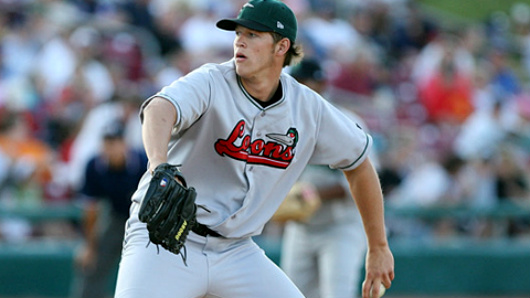
Clayton Kershaw with the Loons in 2007.
Los Angeles Dodgers‘ hurler Clayton Kershaw has won the Cy Young award for being the best pitcher in the National League. With a recor of 16-9 and a microscopic ERA of 1.83, not too many can really argue. Before he became a star on the west coast, however, he honed his stills in the Midwest League as a member of the Great Lakes Loons in 2007. I remember a lot of talk about him back then, like everyone knew that this kid was going to be that good. In 25 starts for the Loons, he ended up 8-7 with a 2.95 ERA. The sad part is, though, I never was able to see him pitch down in Midland. And to think, just one season later, he was making his big league debut with the Dodgers. A new team in 2007, the Loons had Lance Parrish as their manager, who was a member of the 1984 World Series Champion Detroit Tigers. So, the only game I attended that season, I was more determined to meet a local hero like Parrish then an up-and-coming superstar. That was my mistake, though seeking an autograph from a starting pitcher isn’t an easy task. On days they pitch, they’re not allowed to sign autgraphs, and on days they don’t they’re not really out of the dugout, or even in uniform at times. It would have been nice to have seen him pitch, but it’s always good to have alumni do well and make through the system, and in Kershaw’s case excel at the highest level.
Photo courtesy of the Great Lakes Loons
Wil Myers wins AL ROY
 Congrats to Wil Myers of the Tampa Bay Rays on winning the 2013 American League Rookie of the Year award. I was lucky enough to see him play back in May while he was still a member of the Durham Bulls of the International League and even back in 2010 when he was playing for the Burlington Bees of the Midwest League. Wil posted a .293 average, with 13 home runs, and 53 RBI’s this season with the Rays. Just another example to get out to the Minor League ballparks when you get a chance. You never know what future award winners you’ll be witnessing.
Photo property of Minoring In Baseball
Seager speaks with MiLB.com
This past season I was lucky enough to see the Dodgers second ranked prospect Corey Seager play a couple of games with the Great Lakes Loons. Seager had a solid season in his first full year of pro ball, hitting .309 with 12 home runs, 33 extra-base hits, with a .918 OBP to boot. The 19-year-old was promoted to the Rancho Cucamonga Quakes (Single A Advanced) for the second half of the season. He’s currently playing in the Arizona Fall League for the Glendale Desert Dogs, and took part in last weekend’s Fall-Star Game. Having two brother also playing professional baseball must add to the pressure, but he seems to handle himself pretty well. Here is the interview from MiLB.com by Josh Jackson:
 MiLB.com: It seems like this was a really big year for you on a lot of different levels, with you doing what you did in your first full pro season, with the Dodgers having the season they had and with the success of both of your brothers. Have you felt like it’s all been kind of a magical stretch?
Corey Seager: Yeah, you know, it feels like it’s been really crazy, actually. This was [Kyle’s] second full year in the Majors and he was looking to have a good year like he did. For me, I didn’t really have any expectations for myself other than to just play hard every day all season, and I ended up having a good year. I was just trying to get through the season. And it was awesome to see my middle brother get drafted and go to the Mariners and be in Kyle’s organization.
MiLB.com: How much are you able to pay attention to what they’re doing on any given night or week during the season?
Seager: I checked up on my eldest brother [Kyle] every night. We texted or talked every night or almost every night. I kept up with my middle brother [Justin] every week, usually on the weekend. When he was in school, it was hard to follow what he was doing when he had games in the middle of the week. But I’ve gotten really close to both my brothers over the last couple years. We’ve spent more time talking to each other and keeping up, and it’s been really fun.
MiLB.com: And what about following what goes on at the big league level? Obviously, your job is to stay locked in on your game, but, for example, when the Dodgers went on a 42-8 run, how tuned into that were you?
Seager: Yeah, I definitely follow the Dodgers. I was checking the box score every night. My brother [Kyle] gave me the good advice not to ever look ahead. He told me, ‘Make every level your Major Leagues. Don’t push, stay in the moment.’ That’s really good advice. I definitely checked the box scores but not for any other reason to see what they were doing. I checked, but I didn’t put much thought into what might be going on with them.
MiLB.com: Having so much going on on the periphery could be overwhelming for some players your age. Do you have to get into a certain mind-set to only take from that stuff the time and energy that will help you?
Seager: Yeah, for sure. You never want to root against anybody or anything like that, but you can’t get caught up in somebody else’s game. You root for everybody, but you really need to remember that the most important thing, by far, is to handle your own business.
MiLB.com: Since Justin joined the Mariners system, are you feeling a little outnumbered in the family? Are your parents going to root for Seattle harder than L.A.?
Seager: I’m pretty sure I’m going to get ganged up on during the holidays. That’s probably going to happen. But I was really excited for [Justin] when he got drafted. And I’m really looking forward to working out with both of them during the offseason. That should be good.
MiLB.com: Have you guys ever been on different teams in the same league growing up or did the age differences keep that from happening?
Seager: I’ve never played against them. I played with my middle brother in high school for two years but never against either one of them. If that happens, it definitely will be weird.
MiLB.com: Speaking of high school, when you were drafted last summer, were you tempted at all to go the college route? Or after you went where you went in the first round, did you know you wanted to jump in and start working on improving your game full-time?
Seager: You know, I was really excited to go to [the University of] South Carolina and I had a good relationship with South Carolina. I told them ahead of time, if it happens that I’m drafted between this spot and this spot, I’m going to sign. It did happen that I got drafted in those spots and once it happened, I was really glad it wasn’t [on the cusp of my limits], because that would have been a hard decision and I would have really had to think about it.
MiLB.com: Did you know what you wanted to study, if you were going to go to South Carolina?
Seager: Not really. That was something I was still kind of thinking about, still deciding.
MiLB.com: What you’ve been able to do as a pro shows you were ready. You had a pretty darn good first full season. Looking back, is there anything you would have liked to have done differently or any particular part of your game you wish you’d been able to develop more?
Seager: I had a pretty good year, fortunately. There’s not one specific thing I can look at and say I wish I’d done much better. Obviously, you’re always looking to improve on everything. I want to get faster on defense, get to some more balls and just kind of my overall game — there’s all kinds of things I want to improve on overall.
MiLB.com: Is that really what this experience in the AFL is all about for you?
Seager: Yeah, it’s a little bit of a quicker game. I’m getting used to that and working on improving everything against better quality players.
MiLB.com: I’ve heard that the AFL can be especially tough on guys who haven’t faced Double-A pitching before, because there are so many pitchers who can get younger batters to chase breaking pitches that start in the zone. Has that been kind of a challenge?
Seager: Yeah, for sure. Everybody here is a top guy in his organization. Every pitcher has good quality off-speed stuff and throws well and hits his spot. There’s a real difference with the control they have over all their stuff. I’m always hoping to swing at a strike, and [facing this high-quality pitching] changes your approach a little bit. You’ve got to be a little quicker. And you’ve also got to be quicker on defense. I think this is really improving where I’m going defensively.
MiLB.com: Is it kind of weird to be down there playing right now? The World Series just ended and now you guys are kind of the only game in town, the only pro ballplayers still playing competitive games in the States.
Seager: Well, I don’t know. It’s just, my year hasn’t ended. I’m grinding out the year. It’s definitely a little weird, kind of a weird feeling.
MiLB.com: And for a guy who’s just had his first full season — you’ve been playing almost every day for about eight months now, right?
Seager: This is definitely the longest I’ve ever played consistently. Everybody here is a little bit nicked up or has a little bit of fatigue. We’re all just trying to grind out at-bats and play the game right. A little fatigue is a part of it for everybody here.
MiLB.com: What’s the most fun you’ve had with a team?
Seager: Probably making the playoffs [this season], after playing that long season and then to get there. That was really fun.
MiLB.com: Did you go to a lot of Minor League games in Kannapolis growing up?
Seager: I went to a few Intimidators games but not many, really. I was pretty busy all the time playing ball as a kid, plus both my brothers were playing, so we were pretty busy during the baseball season.
MiLB.com: Did you have a favorite Major Leaguer growing up?
Seager: Derek Jeter, probably. I’d have to say Derek Jeter.
MiLB.com: Yeah, for a shortstop, that’s probably going to be the answer, right?
Seager: Well, yeah, he’s a good guy and he’s a good all-around player — he does everything right on the field.
MiLB.com: And if you weren’t a pro ballplayer, do you know what you’d want to be doing for a living?
Seager: Not really. No, I can’t answer that question for you. Sorry.
Photo property of Minoring In Baseball
The Tigers’ organization All-Stars
This time of year, Minor League Baseball honors the players in each organization’s farm who had the best seasons. This season was a good one for the Detroit Tigers‘ minor leaguers, as many of them had some solid stats. I’ve always enjoyed following the players up through the system, especially the ones who played in West Michigan for the Whitecaps. I plan on making trips down to Toledo and Erie, along with my usual stops in Grand Rapids, so I’ll have a good chance to see most of these players next season. It looks like eight out of the 12 selected played for the Whitecaps at one point in their career.
Catcher-James McCann (Erie Seawolves): Suited up for nine games with West Michigan in 2009. This season with Erie, he hit .277, with 30 doubles, eight home runs, and 54 RBI’s. His BA, doubles, along with 178 total bases and 50 runs scored, lead all catchers in the system. Behind the plate he threw out 28 of 76 base runners (1/3), and had a .991 fielding percentage.

Lennerton with the ‘Caps in 2009.
First Base-Jordan Lennerton (Toledo Mud Hens): Played for the Whitecaps during the 2009-10 seasons. This season with Toledo, he lead all first basemen with 17 home runs and 143 hits. He placed second in the Tigers organization with 84 walks, fourth with 57 RBI’s, and fourth with 221 total bases.

Devon Travis had one of the best minor league seasons I can remember.
Second Base-Devon Travis (West Michigan Whitecaps/Lakeland Flying Tigers): Played most of the season in West Michigan before being promoted to Lakeland. Travis was the Midwest League All-Star Game MVP, the Tigers’ Minor League Player of the Year, and won two MiLBY Awards for Breakout Prospect and Offensive Player. He hit .351 across both leagues, and lead all middle infielders with 16 home runs and 76 RBI’s. He was also successful in 22 out of 26 base stealing attempts.
 Third Base-Wade Gaynor (Erie Seawolves): Played for the ‘Caps during the 2010 season. This season with Erie, he lead all players at the hot corner with 108 hits, 179 total bases, 64 RBI’s, 31 doubles, and 12 stolen bases. He also contributed 12 homers and 45 extra-base hits.
 Shortstop-Eugenio Suarez (Erie Seawolves/Lakeland Flying Tigers): Won a Gold Glove last season with the Whitecaps, as the best defensive shortstop in the minors, and a Midwest League All-Star. In 2013 with Lakeland and Erie, he hit .264, added 10 home runs (career high), 57 RBI’s across both levels. He led all Tiger shortstops with six triples and 70 runs scored.
Outfield-Danny Dorn (Toledo Mud Hens): Dorn led all Tigers’ minor leaguers with 25 home runs and 82 RBI’s. He ranked second in the system with 228 total bases, also. He was signed by Detroit as a free-agent in 2012.
Outfield-Tyler Collins (Erie Seawolves): Skipped over the Whitecaps, moving up to Lakeland from Connecticut. He ranked second in the system with 21 home runs and 79 RBI’s, hitting .240, with 29 doubles, and 67 runs scored.
Outfield-Nick Castellanos (Toledo Mud Hens): Played with the Whitecaps in 2011. Was called up to the big team for 11 games this season, but with Toledo he hit 18 homers and 76 RBI’s. He also led all outfielders with 240 total bases and 81 runs scored. His biggest improvement, was cutting down on strikeouts, and drawing more walks this season (54). I’d like to see him starting for Detroit next season in left field.
Utility Player-Daniel Fields (Erie Seawolves): The Michigan native hit .284 for Erie this season, hitting 43 extra-base hits including 10 home runs. He added 58 RBI’s, 24 stolen bases, and 71 runs scored.
Starter/RHP-Wilsen Palacios (Lakeland Flying Tigers): Played for the Whitecaps last season. In 2013 with Lakeland, he posted a 3.07 ERA and struck out 109. He held opponents to a .238 batting average and 1.23 WHIP. Had a 7-8 record in 23 starts, including a complete game. He’s currently pitching in the Venezuelan Winter League.
Starter/LHP-Kyle Lobstein (Erie Seawolves/Toledo Mud Hens): Playing 15 games with the ‘Wolves and 13 with the Hens, he went 13-7 this season. He led all pitchers in wins and with 148 strikeouts. across both leagues, he boasted a 3.27 ERA.
 Relief Pitcher-Corey Knebel (West Michigan Whitecaps): Played for the Whitecaps this season, after finishing his collegiate career at the University of Texas. He had 15 saves in half a season for the ‘Caps, good for fourth in the system. Had an impressive 41-to-10 strikeout to walk ratio, and held opponents to a .133 average, and had an ERA of 0.87.
Photos property of Minoring In Baseball
The Fall-Star Game
 Yesterday was the Arizona Fall League‘s all-star game, properly termed the Fall-Star Game. The game is the half-way point of the AFL schedule for some of the best prospects in baseball. The game also featured two of this season’s most successful West Michigan Whitecaps players, and Detroit Tigers prospects. The West beat the East 9-2, but second baseman Devon Travis and relief pitcher Corey Knebel both made appearances. Travis went 1-2 with a triple and an RBI. Knebel pitched only 0.2 of an inning, giving up a home run, a solo shot, and striking out a batter.
Both players are suiting up for the Mesa Solar Sox this fall, a team that featured prospects from the Tigers, California Angels, Chicago Cubs, Oakland Athletics, and Washington Nationals. Travis is hitting .233, with two home runs, three doubles, and eight RBI’s. Knebel has a 1.50 ERA in eight games, with two saves, and seven strike outs. Three other former Whitecaps playing for Mesa are pitchers Tommy Collier (2012) and Kenny Faulk (2010), and shortstop Dixon Machado (2011). Collier has a 0.64 in four appearances, with 10 strike outs and giving up only one earned run. Faulk is 1-1, with a frightful 11.37 ERA. He did strike out eight and have one hold. Machado is batting .188 in only nine game, and added four RBI’s for his efforts. Other players in the Tigers system that are playing with the Solar Sox are pitcher Blaine Hardy and outfield Tyler Collins.
Photo property of Minoring In Baseball
Logo of the Month: Akron RubberDucks
Aeros to RubberDucks
 More RubberDuck Logos
 Location: Akron, Ohio
League: Eastern League (Double-A)
Affiliate: Cleveland Indians
Home Field: Canal Park
Early this week, another bomb shell was dropped on Minor League Baseball, as the Akron Aeros officially changed their name to the RubberDucks. The name was changed to honor the birth of the rubber industry in Akron, mainly the tire and rubber companies like Goodyear, Firestone, Goodrich, and General Tire that originated there. It is a neat, original logo, and I do like the fact that it relates to the history of the town. The team was named the Akron Aeros from 1997-2013. The franchise originated in Lynn, Massachusetts before moving to Burlington, Vermont. The team finally ended up in Canton, OH, as the Canton-Akron Indians in 1989, an affiliate of Cleveland. The team moved up to Akron in 1997, and was re-named the Aeros after astronaut Judith Resnick, a native of the city who died in the Space Shutter Challenger tragedy. The team has won the Eastern League championship seven time in its history, dating from the beginning of the franchise (1984, ’85, ’86, 2003, ’05, ’09, ’12). The Aeros’ mascot is named Orbit, and he stated he’ll be sticking around, but I assume they’ll have another duck themed mascot with the new moniker. As of now, Akron is the last game we’re scheduled to see on next years baseball trip. They seem to have many interesting concession items (like the Nice2Meat you, a hamburger/hot-dog combo) that I’m sure we’ll enjoy. With all of the history in Akron and Canton, it should make for an enjoyable trip.
Notable Alumni: Albert Belle, Manny Ramirez, Victor Martinez, Sean Casey, Charles Nagy, C.C. Sabathia, Jim Thome, Grady Sizemore
Official site of the Akron RubberDucks
Logos courtesy of the Akron Aeros/RubberDucks
Local players up for MiLBY Awards
 It’s that time of year, where Minor League Baseball lets the best fans in the world vote their best Minor League moments, plays, bloopers, players, and so one. It’s simply time for the MiLBY Awards. Up for two of these awards is former West Michigan Whitecaps second baseman Devon Travis, who was promoted to the Lakeland Flying Tigers in late June. The awards that he’s in the running for, are the Offensive Player of the Year and Breakout Prospect of the Year awards. Travis batted .352 during his time in West Michigan, and .350 in Lakeland. His combined .351 average was the best in Minor League baseball for anyone with at least 350 at-bats. Between the two leagues, he also contibuted 28 doubles, 16 home runs, 76 RBI’s, and 22 stolen bases. Travis was only one of five players in MiLB to hit .330 and steal over 20 bases.

Corey Seager is nominated for the Breakout Prospect of the Year Award with teammate Julio Urias, and rival Devon Travis
Also up for the Breakout Prospect of the Year Award, are short stop Corey Seager and pitcher Julio Urias of the Great Lakes Loons. Seager lead the Loons with a .309 average, and was tied for home runs with 12, despite playing 27 games with the Rancho Cucamonga Quakes of the California League. He also hit 18 doubles and drove in 57 RBI’s with Great Lakes. Urias was one of the best rookie pitchers in the Midwest League, holding batters to a .206 average the second half of the season. The 16 year-old prospect struck out 11.9 batters per nine innings, a total of 67 on the year. Urias had a 2-0 record in 18 appearances for the Loons.
UPDATE: Travis won the Offensive Player of the Year and Breakout Prospect of the Year MiLBY awards, as voted by the fans.
Photos property of Minoring In Baseball
Gold Gloves for former Whitecaps
Yesterday Minor League Baseball and Rawling Sporting Goods released the names of the nine players chosen to receive Gold Gloves for defensive excellence at their position. Three out of the nine happen to be Detroit Tigers prospects and former West Michigan Whitecaps. The 2013 Rawlings Gold Glove Award winners were chosen from all the qualifying players from the ten domestic-based, full season Minor Leagues. Each player will receive his own Rawlings Gold Glove Award, modeled after the iconic award given to MLB’s top defensive players. Taking home the award at first base is Jordan Lennerton, who played with the Toledo Mud Hens in 2013. He posted an impressive .996 fielding percentage, with 1, 167 put outs, and five errors. Lennerton played two seasons in West Michigan, hitting .282 with 71 RBI’s, and a .996 fielding percentage in 2009. In 2010, he hit .290 with a .993 fielding percentage. Covering the hot-corner is Wade Gaynor. He had a .967 fielding percentage, with 95 put-outs, 227 assists, and 11 errors playing third base for the Erie Sea Wolves. We were lucky enough to meet Wade (pictured above) back in 2010 when he was with the Whitecaps. He hit .286 with 39 doubles, 80 RBI’s, and a .927 fielding percentage that year. Earning the honor in left field is Jason Krizan, who just played for the Whitecaps the last two seasons, where he hit .242 with 59 RBI’s, and a .980 fielding percentage combined. This season with the Lakeland Flying Tigers, he had a .995 fielding percentage, 175 put-outs, and only one error in the outfield. Congratulations to all three players. It was fun watching them in West Michigan, and I’ve been enjoying tracking their progress through the Tigers’ system.
“I know what an honor it is for a player to receive a Rawlings Gold Glove Award, having been involved in presenting them to the winners the last two years,” stated President and CEO of Minor League Baseball, Pat O’Conner. “The players really appreciate and understand how prestigious the accolade is and I want to thank Rawlings Sporting Goods for their continued support of Minor League Baseball.”
Photo property of Minoring In Baseball
Parrish takes over Mud Hens
 For the second season in a row, the West Michigan Whitecaps are left without a manager. Unlike last season, however, this change comes with a promotion. Larry Parrish (pictured), who led the ‘Caps to a 69-70 finish in the Midwest League, has been promoted to helm the Toledo Mud Hens in 2014. This isn’t his first experience with Detroit’s Triple-A affiliate, as he managed Toledo in 1994 and from 2003-2010. Under Parrish, the Mud Hens won back to back Governor’s Cup (International League) championships in 2005 and 2006. Parrish has won more games for Toledo than any other manager at 569. It looks like three times a charm for him, as he has some great support from the parent club Tigers, as well as the Hens.
“As a manager, he’s a great teacher, and I know we’ll see improvement in player development,” said Toledo’s general manager and team president Joe Napoli in a press release. “For our fans, he’s always been a favorite, they will be glad to welcome him back.”
“He’s going to be missed,” stated Whitecaps vice president Jim Jarecki to MLive.com. “Having LP on board, he was a great guy on and off the field. He was great to work with and the guys really liked and respected him. Even though the record didn’t reflect it, the players gravitated to him and he was a great leader.”
This is a good move by the Tigers’ organization, and a deserved promotion for Parrish, as he’s already in the International League Hall of Fame. We already have a couple of dates circled on the calendar for season to watch the Mud Hens, so we’ll be seeing him again soon. Now…what about the Whitecaps? The Single-A affiliate is once again in need of a skipper, and it will be interesting to see who the Tigers will assign. I’ve written in the past how I think that Brandon Inge would be a good fit in West Michigan. The Tigers’ have basically stated that they’d like him back in the organization once his playing days are done, and Inge always said positive things about the ‘Caps. We’ll see if he retires at the end of the season, though, and if he shows interest in coaching. Jarecki aslo stated the Tigers should name the ‘Caps new manager sometime in early October, so the safer bet may be seeing the promotion of Connecticut Tigers manager Andrew Graham. He has been at the helm of the C-Tigers for the last three seasons, and before that coached the Gulf Coast League Tigers from 2009-2010. He also served as the Tigers minor league catching coordinator during the 2010 season. This season, Graham led Connecticut to a 33-42 finish, good for third place in the New York-Penn League‘s Stedler Division. He is also a Tigers product, getting drafted by Detroit in 2003, and was a catcher in the organization from 2003-2008. A native of Sydney, Australia, Graham also played in the World Baseball Classic in 2006 and 2009. I’ll be keeping a close eye on who gets the West Michigan job. The Whitecaps have missed the playoffs the last three season, so whoever is chosen I hope they can break that streak in 2014.
Photo property of Minoring In Baseball
 Minoring In Baseball